
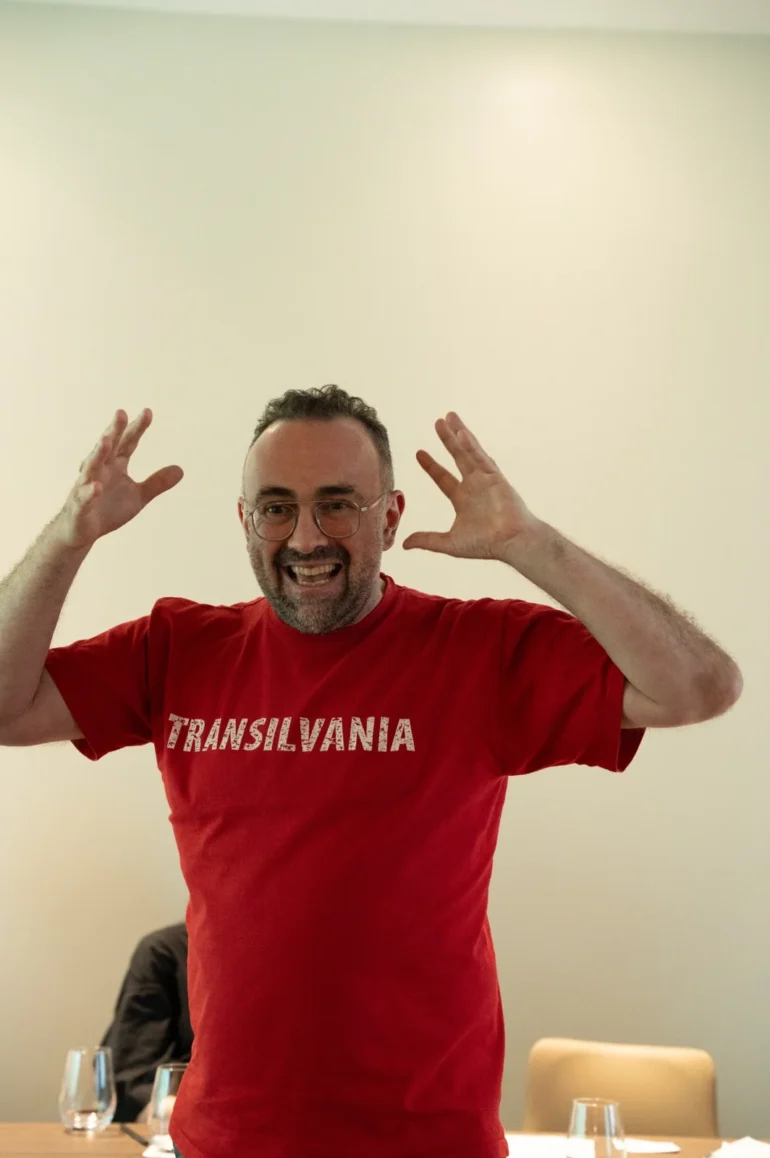
Nikolaj Nikitin is one of TIFF’s longest-standing friends. He is a curator, artistic director, and programmer for several international film festivals, with an extensive career in cultural journalism as well.
You are among the first few people who were involved in conceptualizing TIFF more than 25 years ago. Can you tell us how the idea of the festival came about and if you remember your first discussions with Tudor Giurgiu?
Well, to be honest, I meet a lot of people in my life. I’ve been working in this industry for almost three decades, but I rarely remember a meeting so clearly as the one with Tudor Giurgiu. It was in Warsaw at the Warsaw International Film Festival, run back then by our friend Stefan Laudyn. We met in front of Varna, the Bulgarian restaurant, because we were supposed to meet another friend, Stefan Kitanov, and also a third Stefan, Stefan Otrech, who was somewhere around.
Tudor came to me and said, ‘Mr. Nikitin, I would like to talk to you’, and I said, ‘Excuse me, Niki. Mr. Nikitin is my father or my grandfather, or whoever. So, let’s talk.’ Because I was working for the Berlin Film Festival back then. People recommended me to him as a person to talk to, and right away I felt this energy that I think Tudor – and you all know him – has until today. His eyes were blinking, and he was a bit excited. I wouldn’t say nervous, because he was very self-assured. I asked, ‘So, what can I help you with?’ and he said, ‘Well, you know, I’d like to set up a film festival in Romania.’ I’m like, ‘Oh, wow, that’s great, very interesting. I know there are some smaller festivals going on, but I don’t know if there’s a big one. So, what are your plans? But first of all let me ask you where would you actually take the festival? In which place?’ Because for me it’s always very important where festivals take place. I worked many years in Berlin, which is the capital of Germany, so back then, when we were running it, it was the biggest film festival in the world. It’s in a capital with 4 million people. But then of course, there’s Cannes, which is the number one festival and it’s in a very small place. So I asked him ‘Where do you want to do it?’, and his first answer was Bucharest. I’m like, ‘Okay, I know Bucharest, sounds interesting. Any other ideas?’ Then he said ‘Cluj.’. I have to say, this is all full disclosure: 26 years ago, I didn’t know where Cluj was, so I asked, ‘Where’s Cluj? What is it? Sorry, I’m very bad with geography.’ which I actually am. He said, ‘It’s in Transylvania.’ Then I said, ‘Okay, stop! It’s obvious you’re gonna go to Cluj, because Cluj sounds much better than Bucharest, but secondly… it’s Transylvania. I mean, come on, we are film people, right? Bella Lugosi, he’s not far from here. As far as I remember, he’s originally Hungarian, Romanian… I think he also has some Serbian blood, but this is it. I mean, Dracula, of course, is one of the films that were made most of on screen, and Transylvania, for everybody you talk to, they have a connection to it. So I said, ‘Yes, please do it in Transylvania!’
We started talking and then we met the other three Stefans. I think the legend goes that we had a long, long dinner, the five of us, discussing how this festival should be set up. That it should focus on young filmmakers, that it should not have a mainstream selection, but a very edgy selection, which my beloved Chiri (Mihai Chirilov) is still running until today.
I think the Cluj competition is one of the edge-breaking competitions, and we were very clear in the first talks, and Tudor understood this, that setting up a new film festival would be very needed, also to support Romanian cinema. Then we talked about the early zero years. I think in 2000 there was not a single Romanian film produced for the big screen. And then, as you all know, in 2003 I think, Stuff and Dough by Cristi Puiu ran at Cannes and then there was Coffee and Cigarettes, which I had in Berlin in 2004 and it won the Golden Bear for the best short film, then in 2005 was The Death of Mr. Lăzărescu… In between I visited Tudor because I had an idea to do a so-called omnibus film with six young directors, and I wanted Romania to be involved. So he introduced me to some people, and we ended up, or I ended up choosing Cristian Mungiu, who funnily enough, I also met in Warsaw the same year. Then we did Lost and Found with Jasmila Žbanić, Kornél Mundruczó, Mait Laas, Stefan Arsenijević, and Nadejda Koseva, which was released at the Berlinale as the opening film of the Forum in 2005. Then Mungiu won the Palme d’Or in 2007, and just a couple of weeks ago with Fjord, the second Palme d’Or. Now he’s one of the 10, or let’s say 11 filmmakers (because the Dardenne brothers are two people), who have two Palme d’Ors.
And there were also Corneliu Porumboiu, Radu Jude, Călin Peter Netzer, at the Berlinale, of course, Adina Pintilie, with Touch Me Not, which won the Golden Bear. All these filmmakers I’m mentioning (I’m forgetting many of them) and outstanding producers like Ada Solomon, Anamaria (Antoci), all the names, they were all connected to Cluj. Tudor, got together with Oana and Cristian (Hordilă). For me it was always amazing that in Cluj it was never only Tudor, but it was this great team of people from the beginning until now. Tudor, Oana, Cristian and Chiri are doing it together and are very much aware of how to run a film festival in the most professional way, because Tudor and Oana are basically producers and for me this is maybe the secret of TIFF’s success. That it’s run by people who not only have a very good taste in cinema, like Chiri, but are also producers who know how to organize a film circle. They know how to be on time, they know how to choose a great location, obviously they know how to choose a great cast, like Ornella Muti or Alexandra Maria Lara. It’s very similar – organizing a film festival to organizing a shoot.
I think this is why Cluj and TIFF have such a wonderful program, and are not only supporting and doing so much for Romanian cinema, but are also considered by the outside world. Let’s not forget that we have 40,000 festivals around the world, and Cluj managed within this network of these 40,000 festivals to be one of the top 40, and this is due to the amazing work of this whole team. And of course to the city of Cluj. and the municipality and the mayor. I remember last time I was in Cluj I landed, and at the airport there was a banner on the whole airport building saying ‘Welcome to TIFF!’. You know, I usually arrive at Cannes or at Venice, and at the airport they have a small advertisement: ‘Welcome to Cannes Film Festival.’ Last night, passing one of the buildings, I saw a poster, which I think was 30 – 40 meters high. So they are doing everything that a film festival can do, already for 25 years. Still with a lot of soul, and they don’t stop. They are not saying, like maybe some of our colleagues, (I would not mention names) ‘Okay, we achieved that, we’re gonna cool down, and we’re gonna take it easy.’. They’re constantly on the move, improving the festival, making it better for the festival, and the great advantage is that they do so much, especially in the industry part. I had the honor to do a workshop yesterday for the Transylvania Talent Lab, and there’s the Transylvania Pitch Stop, where are works in progress of bits and pieces and finished films.
So they are not only going with an already established filmmaker like Corneliu Porumboiu. And it’s great that Corneliu is here showing all his work, but also that there are always young filmmakers coming here.
For me this is one of the best examples that it’s really growing for 25 years. I see people constantly coming here. I think now I recognize even some people coming here with their children which is, of course, for us very important, because we all believe that you have to watch films as a young child. So then when you’re a teenager, when you’re an adult, you still believe in this love for cinema and this is what Cluj is doing. I think, not only for Cluj and Sibiu, and whatever is around, but also for Romania.
I know that Romania has a very difficult cinema situation, because unfortunately, for such a big country, there is only a number of cinemas. The cinema network is not as it should be, and it’s all the big comedies that are successful and there’s not enough space for the serious arthouse cinema of Romania that is winning all the awards at all the big festivals: Berlin, Cannes, Venice, Locarno. Then they come home and they get almost no attention. So Cluj manages to do a lot, and I would say not only for Romania but for the whole region of Central and Eastern Europe. It’s really a role model of a very successful festival. What I mean by successful festival is, let’s say, just pure numbers of industry professionals. So it’s not only me, but it’s many colleagues from the regions and festivals. I had lunch the other day with, I think, five or six representatives of French sales companies. We all know that France is one of the biggest players in Europe and French sales companies come here, and for me that’s great to see. Because I’m really coming here since the very first edition, and I think I only missed three or four editions due to personal reasons, so I know what to expect. But it’s so wonderful to see that somebody comes for the first time, and is really impressed. The French sales agents I talked to said, ‘Yes, we heard it’s very good, but seeing it with our own eyes, we are even more impressed.’ So, I really have to say ‘Mulțumesc!’ to Tudor, Oana, Cristian and Chiri, and the whole team: Ami and Alex from the industry partner, who did such an incredible job giving so much to the Romanian audience, the opportunity to see great films. And also – and I don’t want to underestimate this – to the Romanian filmmakers to have a place to meet and to connect with the outside world. Because obviously no Romanian film nowadays (if we talk about arthouse cinema) can be done without co-producers from France from Scandinavia, from Germany, and they basically meet here.
Did you get to watch some films during the festival? And what do you think about the selected films, do you have any favorites among the films presented this year?
So, I love them all equally as my children. So, as I’m a colleague of Chiri and he’s also my curator, so I would never give in an interview any favorites, because then I will miss out some others. So, let me please tell you that just the overall selection is brilliant. It’s very well done. I know many films, I enjoyed many films. I want to congratulate Chiri, who for 25 years, manages to surprise me, because he has a very eclectic, a very personal, by the best meaning of the word, curatorial thin thread line, and that I really appreciate. I think he’s one of the few film professionals, not only in Romania or in Europe, but I would say around the world, with such an exquisite, clear, and old personal taste in cinema. He’s very much able, because he has a history working as a film critic, to express and to communicate that taste.
Would you change anything about TIFF? From your perspective, as film curator and programmer, now that the festival has reached a certain level of maturity, how can it maintain its freshness?
Wow, that’s a very big question. It’s always easier to give advice when somebody starts. I don’t think that I’m in a position to give advice, because I think they all outgrew me by now with all the dedicated passion and work, but I know what you mean. It’s not an advice, but a thankful hint: keep believing in yourself and keep believing in the work you do. The most important thing is that they keep the friendliness, the hospitality, and the familiarity of the festival, and they are aware of this. Each guest that comes still feels very special, each filmmaker who presents themselves feels very special. The most common mistake I’ve seen at other festivals (I will not mention which ones) wat that they were on such a successful path that from one moment they just overgrew themselves. They have maybe too many films, too many guests, and they were not able to take care of that.
But I feel that here everybody is very much taken care of, because the team is amazing, and because I also see how big the team is growing. I can’t give any advice, because they know that they are very realistic with what they have, with what they can do and with what they can actually deliver.
It’s important to keep this connection with Romanian cinema going, you know, because maybe there will be one year when there’s not going to be a Fjord at Cannes, or maybe two years without a big success, because we all know that the funding situation is very complicated. Still, I believe that this country (and I also have to say Moldova, because we always consider them) believes this, and they keep going in an outstanding way. It’s now the 25th edition. If we would be talking about a wedding, I think it would be a silver wedding, right? I can’t wait to look for the golden wedding, which would be the 50th edition. I hope I’m still gonna be around. We’re all gonna around, but for now let’s look forward to the 30th edition. Let’s be more realistic. I’m looking forward to keep coming back the next years, because I know that whenever I come to Cluj, whenever I visit Tiff, I find a new experience. Even so, I’ve been coming here more than 20 times. Each time, there’s a new experience, you know? I meet somebody new, I see a movie that maybe I’d missed at the other festivals, and Chiri found it. I’m completely impressed by it. What I also love the way they support the history of Romanian cinema also discovering some archival secrets here, which is very important. So, it’s very important that they keep taking a lot of care of the history, that they don’t lose the history of Romanian cinema. Because we only understand the present and capture the future if we know the past. This is very important. Keep going on and believe in cinema and Romanian talents. It’s as easy as that. They all know this, and it’s very goor. Mulțumesc and keep going, guys and girls!