
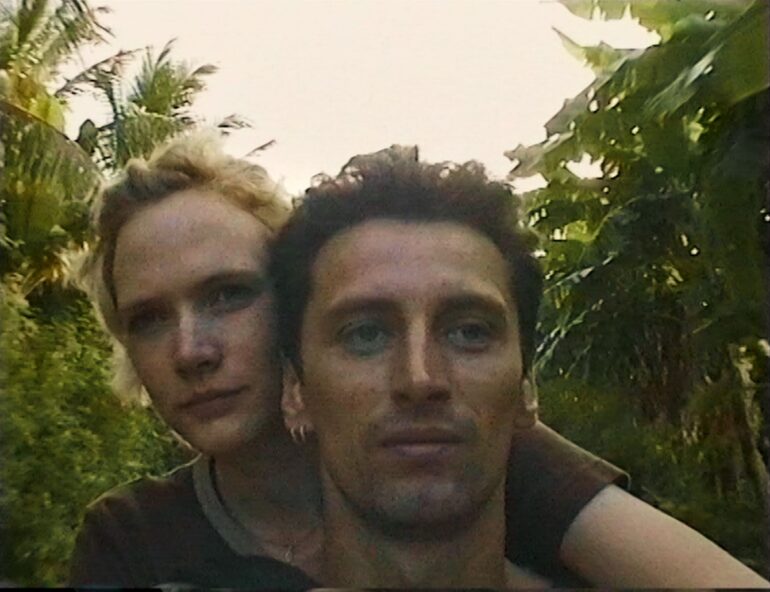
de Anais Dragu și David Seko
After watching Love-22-Love, we found ourselves wanting to love more, create more, and embrace the act of creating itself. Few films manage to be so intimate and generous at the same time; fewer still leave you feeling that life, in all its beauty and darkness, is worth documenting.
Naturally, David and I felt compelled to meet the person behind it. Jeroen Kooijmans, the Dutch artist and filmmaker whose decades-spanning archive forms the heart of the film, welcomed us with the same openness and vulnerability that define his work. What followed was a conversation about love, memory, filmmaking, family, mental health, and the delicate process of turning a life into art.
DAVID: My first question, I was curious, maybe, because I find it very interesting that you always had the camera with you, that you were recording everything. And I’m curious if you felt that having a camera and the possibility to record everything made you experience things in a certain way, maybe like a temptation for cinema, for showing something different, more beautiful or more interesting. Did it change the actions that you do? Or it was you do all the same and you just happen to record?
Well, like in the 90s, the cameras were like this big. So I didn’t carry it always with me. And yeah, it looks like if I had the camera all the time. But let’s say I was interested in all kinds. I mean, I have like a pencil to write and to draw. And then I had a camera and the camera became more important it was becoming a bit an extension of my body kind of thing.
Like before I was always thinking in painting and imagine like: this could be an interesting painting. And then I started to make film, a video I mean. Of course, in painting, it’s all static. So I started to think in movement more. So the movement is very important.
The first video is the diggers that you see in the movie. And yeah, I was trying to do this without movement. But then I needed the movement to actually say what I want to say.
But the bigger camera, like the shots that are like my self-portraits – we had the assignment in school to make a self-portrait. And I painted already so many self-portraits. So I thought to make this metal thing and then put this camera on and then film myself for 24 hours and see what happens kind of.
In the film, there is quite a lot of footage of myself, because of the editing. I told them maybe not to put me in in the beginning. I thought maybe it’s more interesting to tell the story and show me in the very end of the movie, like or not even. But then it became more and more like a diary and a video document about me. At one point I was the director of the film and not the main character. That made it easier to accept my own stupidities.
ANAIS: It’s interesting that you say that you were the main character, because in the beginning I thought, also from the trailer, it was going to be a love story. And it still is a love story, like continuously, but at one point, I feel like it shifts more towards your identity, also your journey with your mental health and everything else and how you know, perceive life and perceive love, perceive your family. And was there a point where it went from love story to more identity?
Yeah, well, my turning point was that I came to the realisation that I could not love, purely, my wife and life if I didn’t love myself. So basically it became a love letter to myself in the end.
I thought that’s a very interesting way of making this story. I mean, you don’t have to be in love with yourself, but at least you have to accept yourself as you are and then you can love. And this was the lesson.
ANAIS: But was your goal to make a film from the very first time or is it an idea that came up at some point?
I mean, I’m a maker, so I’m always creating. So, basically, I sketch with the camera. I sketch, I write, I film. And then, let’s say, 10 years ago, I was in a very dark moment in my life and I had an accident that was actually very painful. In the film we translated it as if I crashed with the plane. But actually, I was making an artwork, five metres high, I fell down on my knee. I broke some ribs and my knee was not broken, but like almost.
So then I couldn’t walk for one year. I was frustrated and I couldn’t play soccer anymore. My biggest antidepressiva.
And then I was in such a dark moment and had to move to a smaller place. I saw all these boxes, like really a lot of tapes. I thought, I’m going to throw them away, but then one museum in Amsterdam constantly asked me if I could find a tape. I went through these boxes and then I found my wife. And then I saw her dancing on the river and I was really like, wow, I want to do something. That was for me a point of light that I was not looking for, but I found it anyway. And then I decided to make a work for her basically like the first four years, in the beginning.
It’s a lot of material, it’s also very boring, but it was a therapy for me as if I was doing my memoirs. The first four years, I thought only about making a film about love and that my end scene was this happy living ever after scene with the marriage.
And my family didn’t know that I was making this film. So that’s also why they didn’t like to do it twice, because it was a secret. They knew then that I was busy with a project about love. I also made a project in Beirut, By the way, I love you. And so they knew he’s busy with love somehow, but they didn’t know I was making this film also. Then I felt like, I really have to tell them that I’m doing this after four years in secret.
ANAIS: So your wife did not know anything about the film up until later in the process?
Yeah, after the marriage, I felt so guilty and so stupid. I felt as if I had an affair with my own wife. In the beginning, I made a present for her, like a private, intimate situation. And then it turned into an artwork. Then I felt also guilty. I told her, like, I’m going to make a portrait of you.
And then she said, like, well, I’m not sure if it’s a portrait about me. I think it’s more about how you see me. And so it’s more like a self-portrait already without you in the image.
She got a veto. Like, she could say yes or no.
In the beginning, I had some very beautiful sex scenes in it. Like, very poetic. But my wife took it a lot. And I’m very happy with that too.
ANAIS: I also thought you were very self-reflective and self-conscious during the movie. Even in the wedding scene, you admitted that you shot it twice. They didn’t feel comfortable and you were self-critical as well, self-aware. I think it’s a nice way to share your thoughts and you meditating on things that also affect the people around you. Did you watch the film together with your family?
Yeah, I did.
ANAIS: And what was that experience like?
When I started the movie, when I started this idea, they were very small. The youngest was three. Now, the oldest is 20. And then the other two are 15 and 14. And so I thought that maybe they need to be 16 to see this movie. But then the premiere was IDFA, it’s the festival in Amsterdam. And I mean, the whole family and all our friends were coming.
ANAIS: So did you watch it the first time in the premiere?
No, no, no. Then we decided they can see it, we show it to them like in a family evening. We bought some popcorn and then my wife was really, like, amazingly funny, because she was constantly telling anecdotes about us in a certain scene. Also in the bit heavy scenes, she was making it a lot lighter and making some jokes. And we had to laugh the whole, like the whole film. It was just like as if it was a comedy. The premiere was in a very big cinema, Tuschinski, and it was sold out. And so I was sitting with my wife and children and they, the film started and they had to laugh again a lot because they were still thinking about anecdotes and it helped a lot with the whole audience. If one is laughing, then everybody feels a bit like we can laugh. So it felt very comfortable, because sometimes I have screenings and I don’t hear anything and I think, oh, my God, it’s such a dark movie.
ANAIS: Do you think some people take it too seriously?
If I’m in the audience and somebody walks away, it’s painful. I think, oh, my God, is he going to the toilet or is he really doesn’t like it? But of course, people don’t like this movie. So that’s very clear to me. Art is always like this.
ANAIS: Do you have the same feeling when people criticise your art, your exhibition?
No, I don’t. My ego is not so big. I know that in art, it’s a different world because this film is made for an audience.
In art, I never asked somebody before to advise me like, hey, this is my project. I don’t test screen it to an audience, I don’t invite public to see my work and ask what they think. Because in art, it’s mostly poetic; you can like or not like [it] or you go into it or you don’t. And so for me, it’s very normal that maybe only 10% feel something about it and 90% looks at it and just passes the work and it’s like normal.
But in the film, we actually did quite some screenings before. And I was very curious, like we invited 50 people that I didn’t know. And then I asked them like, OK, what, what, where was the worst part of the movie?
I mean, that was also what I wanted to learn, like how do you tell a story with that is clear but not explaining too much? I mean, explanation is for me very painful.
But so to make a film with space, but that people get maybe a bit not lost, but to take them by the hand and go to another space. This was my idea, like to have an inner landscape, maybe road movie in dark valleys and high hills. And then the rise and fall of an artist.
It’s very good to check with the audience because film is made for audience. I can make a very abstract movie that nobody can handle. That’s not so difficult, but my goal was to make a movie that was actually telling the story in a poetic way in my visual language, but then still is doable.
I also like the idea to show it on television, for example, where basically everybody is watching. And then still, there will be a certain group who is actually interested in it. But the wider the spectrum of people, the better I like it.
DAVID: And how do you decide to film something? You see something, what makes you want to film it?
Well, there is the visual language that I have and there is like things like mirroring. So I see you two times, I immediately see that, like, I feel it and I see it.
I just see things, but sometimes I’m also fishing, basically. I was in Ukraine and then the air alert goes and I was at the beach and I thought like, okay, going to the shelter, maybe I should just put on the camera and see if there is a drone coming somewhere. So then I just put the camera on and wait for 15 minutes and then there is no drone.
And then, for example, I was collecting passing boats and I put on the camera, there is a sea and just a boat comes and goes through this and then goes out. And yeah, maybe it’s also boredom, you know, what should I do? And then once you have hundreds of these boats, it starts to become interesting. There is a work that I made and it’s called Cargo. It’s on my website and it’s actually a boat. It’s passing the Twin Towers.
It’s like there is nothing and then you see the city, New York, and the boat is passing. So, there is Twin Towers, the boat passes and they are gone. So, that’s kind of, yeah, like you have this whole archive of like passing boats, mirroring, shadows, air, I always film every aeroplane I take, I film skies like from above.
In the beginning, I told my edit team maybe it’s interesting to have these diaries in an aeroplane, that’s the glue for the film. It didn’t work at all. There were more ideas that I had in mind and they didn’t work at all.
But so, I never film with the idea that it can be something. But I know that it’s also inspiration. I never know where the beauty is. But if you film 35 years or 33 years, whatever, then, you have this visual language .
ANAIS: Why did you choose to show that image of you riding a horse in slow motion into the sunset?
I thought like, when I shot the film, it was actually meant for the next film that I thought of. There is a lot there that’s not in the film. I decided to make a scene where it’s a futuristic scene where it’s five years later. I have this theory of five years. And then, I was trying to put myself on the horizon to look back.
I don’t know if that’s clear. So, I have five years to live. And it goes very slowly. I mean, as we speak, it’s going. The time ticks. And then, here is the horizon, but you can never reach the horizon kind of thing, right? So, the five years stay five years. And then, I thought I’d jump to this place where it is the end and then look back.
And then, I asked my daughter. Then, she was 17. She took a course in makeup, made me five years older. Well, it was a bit more than five, I guess. And then, we did this whole scene. And then, the galloping horse, I really love this as an epic, like an end of a movie scene. Like going into the sun. I thought this is a very beautiful end of a movie. And then, it wasn’t. I wanted that absurd optimistic end on the film.
The editing put in artworks, as well, at one point, but what I first told them, was that I don’t want to make a catalogue of my work. I just want to tell a story about love and darkness.
But then, the art came in anyway. So, I was making an artwork with a lady dancing with a plant. And so, I had this other idea of a lady getting crazy and then decides to dance with a plant. I don’t know, like a very simple idea.
But then I did the test and I asked my wife, like film me and I will do the tryout. So, I went naked. And then when the edit team came up with this footage of me dancing with a plant, I said, no, I’m not going to dance naked in front of an audience, like it’s not going to happen. But then I was still the main character talking.
So, at the point I was the director of the film, so then that’s really a very good scene actually to do. So, that was something that was like a conflict sometimes.
What is interesting for me is this team was super good. Let’s say, they are very professional, but they are very involved, they were just totally into it and doing many more days than they were paid for, and stuff like that.
It was just my idea that it is maybe good to have all kinds of people in your team. I have a very old sound designer, I was very happy that he wanted to do it, and this Victor I was talking about, he is 33, I think, and everybody is 33, 35, and then all these people, I needed some really experienced guys as the sound designer, because I love to take risks. So, for me, crisis is a very positive thing, and for them it is really horrible.
And the editing was amazing. I used two editors, because the first one was super good at the story, but the things she wanted in, they had to be in, kind of, like she was so clear about it. And then, so we were negotiating. But it is also that I have all the anecdotes in my head, and I some things are just, for me, not interesting, because I know what was behind the scene, but that doesn’t mean that the rest of the audience doesn’t know.
But then I worked with the next editor, and then I took all the things out, and said, okay, this out, this out. And then we just continued as we were, I mean, the whole structure was already there, so it was not so difficult. We still did.
ANAIS: I was wondering, because you did have a lot of footage and it started from the 90s. In the film, when you start going through your journal, you say that you feel like you haven’t changed at all from when you were writing. Did you feel the same when watching the footage you took 30 years ago?
Well, let’s say the diaries, they are very… I write a lot when I don’t feel well. So, if I start reading it, then I think like, wow, there’s so much depression all this time. And I don’t feel that I’m a depressed person or like a sick person.
Not at all sick, but let’s say I have this handicap of having this mental issue. It feels a bit like asthma maybe or some people have something and they just need some medicine sometimes. It’s not handy, but it’s not a big issue.
But basically, I didn’t want to have this sticker, crazy artist on my forehead because then you get into a certain category of artists. And I just want to be normal, like everybody.
But, no I did not change. I mean, I can also not really change, I think. But there is also no need to change.
Well, to read back 35 years, it’s also a very long job to do because it’s a lot of text and a lot of… I must say, boring parts and so, but I was working with a film coach and he is the hero, basically, of this story.
After some years, I asked him like, hey, can you look at my film or my footage? Can we do a brainstorm or something?
Then the corona came and then I showed him what I had, like one hour, maybe. He was really amazed.
But I still only wanted to make a love letter for my wife.
But he showed me, I think, more than 100 films and analysing why this is a good movie and how to tell a story.
He saw all these books, like my diaries and he said, why don’t we try to put on the footage and take a book and just read it for me? So I was reading and it was working so well. He asked me if he could read all the diaries. So he said, he’ll digitalise them while I’m reading them. So I had two years film academy privately.
It was beautiful. And then he was taking me slowly. He said, why don’t you put yourself in the movie as well? Like, why don’t you tell the story from a dark point of view?
Your wife is beautiful. 20 minutes, 30 minutes. Then that’s the max that people can handle. Only love and only light. But if you want to tell a story, you always need a drama. And if you want to make a documentary, yeah. Why are you not honest? And why don’t you tell?
I mean he took me like very slowly by my hand into the dark. And then I realised it’s not that scary. And so he helped me a lot. He’s the hero. Viktor.
ANAIS: I feel like that’s really beautiful. I think it’s a slippery slope when filming your personal life, in a documentary, if you don’t show yourself and you’re only showing other people being vulnerable. It’s not really… It’s not even ethical.
I think so too. If you don’t put yourself at risk, there is no point to make the film.