
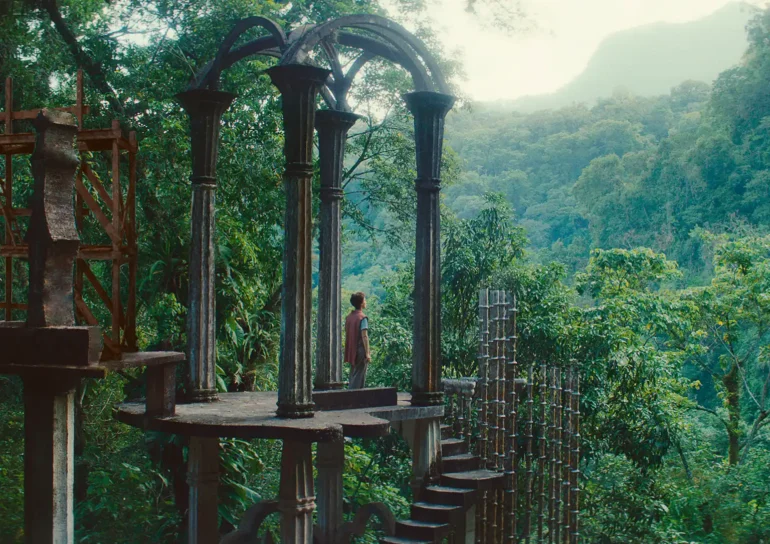
Whenever we hear about Surrealism, names like Salvador Dalí, André Breton or René Magritte come to mind, as male figures who pioneered and dominated the artistic movement. We rarely come across female figures, who are often referred to merely as the muses of these artists rather than as artists in their own right. Thor Klein and Lena Vurma, the directors of Leonora in the Morning Light, are talking to us about a fascinating character.
What made you explore the destiny of painter Leonora Carrington, interpreted by Olivia Vinall?
Lena discovered Leonora 2015 through the self-portrait with the hyena and the horse. She then told me about this amazing artist and woman. A year later, I came by coincidence across the book Leonora by Elena Poniatowska in a library in Berlin. The book balances between a journalistic account and a piece of great literature. The book contains an impressive scene in the South of France where Leonora’s interior world falls apart while at the same time the world around her collapses due to WWII. This stroke me as a very cinematic image. We optioned the novel, flew to Mexico and met Poniatowska, who was a close friend of Carrington as well. This is how our adventure started.
The film carefully depicts the deterioration of Leonora’s emotional and mental state throughout her life. It must be a difficult job not to portray such a character as a victim of circumstances and the film manages to strike a balance in this regard. What was your mindset when you first set out to portray and write Leonora’s character?
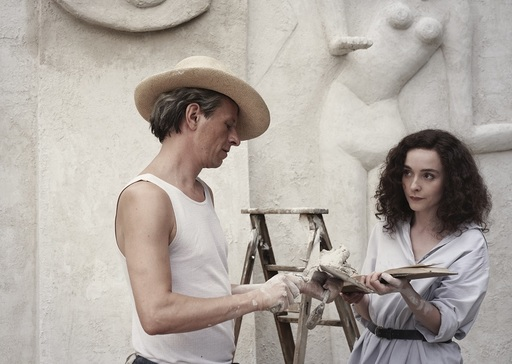
Our first attempt was to find out how Leonora’s everyday life in Mexico looked like. What did she do when she would get up, who would she meet, how and where would she work? To adapt a work of great literature you ironically have to free yourself from it to then take a fresh look, because the writing is so good, you are tempted to think you have it all and just need to start filming. That`s of course an illusion. The book felt more like a beautiful cave, that we could explore and we could take things from it, but we had to transform into cinema. For us it’s a film about resilience – Leonora experienced many traumas, but she pulled through all of them and never stopped creating. It was important for us to tell a story with a hopeful ending. After all Leonora lived and worked well into her 90ies!
You chose to tell Leonora’s story in a non-chronological order. What influenced this decision?
Lena and myself always felt the film has to start in Las Pozas, the surrealistic city in the jungle. It rejected a conventional structure from the start. Not surprising when you deal with surrealists. Every dramaturgical choice you make in depicting a real life has to fall short, because a life is indefinitely more complex than a film-plot. We wanted to avoid to intellectualise her work. It is a journey into her world and into the powerful imagery she created. The film is a very sensual experience and full of conflicting feelings rather than serving a classic three act drama structure. It is supposed to be felt through, not thought through.
What should we expect to see next? Are you still interested in exploring biographical dramas for your next project or do your artistic interests lie elsewhere nowadays?
The next film is loosely inspired by a dear friend who passed away in the Scottish Highlands a couple of years ago. It involves a lot of myths, water and animals. We call it a ʿCeltic Noirʾ. That’s all we can tell so far…
Sunday, June 14, 20:45 – Cercul Militar
Monday, June 15, 12:00 – Cinema Arta