
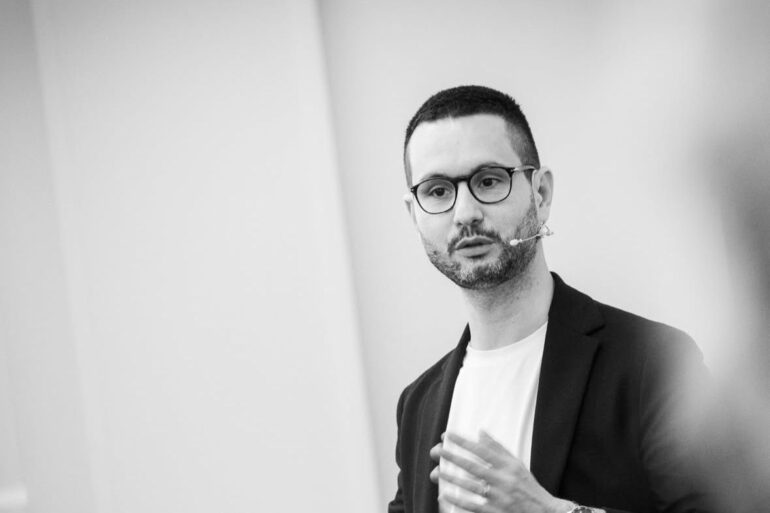
Alex Trăilă, Programme Manager Series Co-Productions, Council of Europe, spoke to us about his work and views on European TV Series production.
First of all, welcome to TIFF! Are there any films you plan to see at the festival?
As I’ve been living abroad already for 5 years, I hope I will catch some of the fresh Romanian premieres during the RoDays.
Can you tell us about your work for Eurimages in the Pilot Programme for Series Co-Productions?
Eurimages is a cultural fund supporting the co-production of cinematographic works. It is the first and oldest supranational fund of its kind. Its home is the Council of Europe, an organisation of 46 member states, known to many through the European Court of Human Rights and the Venice Commission. I joined the Council of Europe five years ago to explore whether it could play a role in the field of series, through Eurimages or otherwise. That work led to a new fund, built on Eurimages’ DNA but tailored to series co-productions.
The fund is now in its pilot phase since 2023, hence the rather long title. We offer top-up grants for series co-productions, development awards through partner markets and with the European Broadcasting Union, and, more recently, support for training initiatives. This year we also launched Culture on Screen, which looks at the societal impact of series: their cultural success, democratic relevance. In short, we are asking whether success can be measured beyond economic indicators.
How is the production of series different from the production of films?
In many ways, the two are similar, but there are two fundamental differences. With a film, you rarely know what its life will be, even once it is finished. You cannot be certain of its festival premiere, distribution prospects or market appetite. With series, you engage indirectly with the audience much earlier. By “indirectly”, I mean that you need to convince a broadcaster or platform to join the project at an early stage, and they bring their knowledge of their audience. Once they are on board, you usually have a much clearer idea of when and how the work will reach viewers.
The second difference is the role of broadcasters and platforms. At minimum, there may be one involved; in some strong projects, there may be nine or twelve broadcasters behind a series before it reaches the market. This makes the process and business approach more structured. Some may see that as rigid, but I would not call it rigidity. In many cases, it is simply a clearer business framework.
What is the work that a debutant scriptwriter has to do to get a series financed?
In my view, the first step is to work very carefully on the idea: the concept, the universe, the characters and the narrative engine. Do not rush into writing scripts too early. A producer should be involved as early as possible. Producers are often the ones who can bring broadcasters or platforms into the project and help position it properly. There is no single recipe, but series are, even more than films, a team effort. Having the original idea and shaping it does not always mean that you will write everything yourself, or remain in full control of every comma and full stop in every episode.
What’s your opinion on the TV series landscape in Romania?
Romania is, in my view, still untapped territory when it comes to talent and stories. At the same time, it is shaped by difficult market dynamics. There is room for local broadcasters to be more open to investing in what Romanian producers and writers bring to the table, and to co-production, which can open many doors for everyone involved and reduce significantly the risks by having it shared rather than all on one pair of shoulders. Producers, in turn, need to accept that the days when one broadcaster financed everything are gone.
In your articles post-Cannes you were writing about the “incapacity of transforming excellence into continuity” as our biggest failure in the national film industry. Do you envision any solutions for this in the coming years?
I would not call it a failure. It is more a personal reflection, looking back. As with any policy-making process involving multiple interests and stakeholders, it helps if everyone first agrees on what they want to achieve together. Only then can they move towards shaping the rules and guidelines. As with creation of a series, everyone may be right and everyone may have a point, but not every point will make it into the final version. Expectations also need to be clear. What is needed to achieve cultural success may not be the same as what is needed for commercial success. The two do not exclude each other, but the expectations behind them should be clear, because they shape the process.