
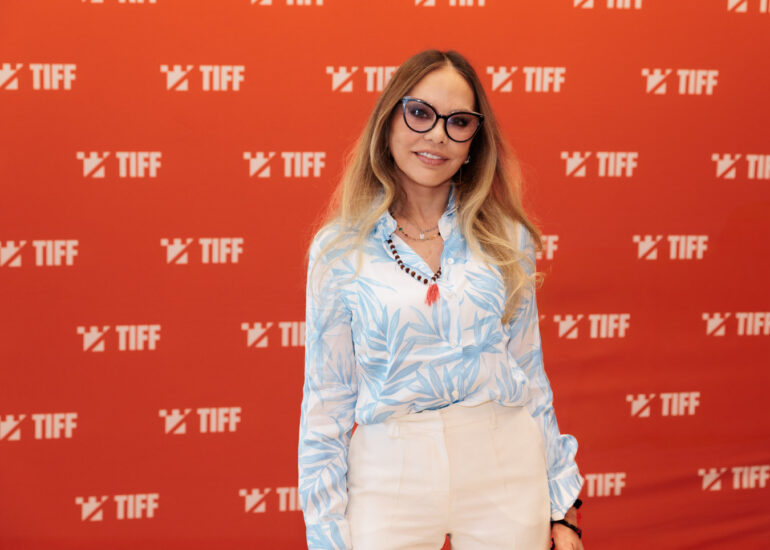
The scent of fame lingers; it leaves behind a trail of nostalgia and achievements, yet when it comes to women, that signature aroma is inextricably associated with beauty. Ornella Muti is nothing short of that: elegant and tenacious. From her presence and presentation at the TIFF masterclass, all the way to the golden age of Italian cinema. She left behind an iconic media footprint, working with visionaries of Italian filmmaking such as Ettore Scola and Federico Fellini. Names like The Most Beautiful Wife and The Taming of the Scoundrel are forever imprinted in the minds of the public. Today we had a poignant discussion about acting and the film industry, all under the loupe of the male gaze; the weight an Italian icon and actress carries as a woman. What does it mean to be a professional, and what Virginia Woolf called “the angel of the house” simultaneously? Ornella switched the narrative, and we looked at it all through a “female gaze”.
It’s lovely to meet you. How are you finding Cluj so far?
Well, fine…
Fine?
Fine, I’ve been in the hotel most of the time, and went to the cinema for one minute, and I hope to see something today…
Hopefully, yes! I was curious about your experience so far before we started diving into some more interesting topics, such as coming to TIFF.25 as a special guest and receiving the Lifetime Achievement Award. I would love to know: how do you experience this kind of recognition at a festival that places so much emphasis on the direct encounter between artists and audiences?
It’s actually wonderful, because, you know, it’s what we do. We’re actors, and when someone appreciates you, it’s a present. On top of that, being in a festival makes people know you. All these people who come, they see a movie, and then they go search for you. It is important for an actor.
Indeed! Now, you’ve lived several lives within one career: actress, public figure, mother, and now a cinema icon for multiple generations. When you look back at your younger self, what surprises you most about the woman you’ve become?
Well, I would have never expected that, because when I did my first movie, I did it by accident. I brought my sister, the role [was also] for a 14-year-old girl; and I always thought I’ll do this movie and I’ll go back to study, and then it was like a snowball and it really – I don’t know – it was just a surprise for me…
Yeah, of course!
I would have never thought.
May I ask what you were studying at the time? My interest has been peaked as a student myself
I was studying languages!
Fascinating! Now going back to TIFF for a second – [the festival] speaks of you as a legend of Italian and international cinema; how do you relate to that status today, after a career that has crossed so many styles and film cultures?
In what way do you mean?
Let’s put it this way: how do you feel Italian cinema is changing, as you are evidently fully immersed in the art and technique of it all, per se, as an actress? How do you resonate with that? How is it changing…
Things have changed a lot, especially because before, there were producers that would put money into producing a movie, so it was different. Today, there is a lot less money, especially in Europe, so it takes a long time to produce a movie if you don’t want the platforms inside. When the platforms go inside, they change everything. They change even the little things like the thoughts of the director, which… spoils the pure thought of the director…
So you would consider that films nowadays, specifically Italian cinema, has become a little less “pure” in a sense?
Yes, unless you speak about Sorrentino, for example, who does not need a platform, but small directors that maybe have wonderful stories – it takes them years to produce, and sometimes they have to say “okay, I will let the platforms in”, and they (the platforms) are not artists, they want the marketing, and that is it. It is spoiled.
Do you think there has been some sort of loss in “auteurs” concerning Italian cinema, then?
Yes…and it’s all because of the money.
I see! Now let’s talk a little bit more about you as an individual. Throughout your career, your beauty has often been discussed alongside your work. Did you ever feel that people were looking at Ornella Muti before they were truly seeing the actress behind her?
Yeah, of course…
Yeah?
…but that’s how it is.
How do you resonate with that? How do you feel about it?
For a long time, I was just struggling to do the movies, but then, you know, it’s up to you to change this thing. On top of that, I’m getting older so it would be just stupid to be stuck to that. So you have to act; go to the theatre and act there. It’s up to me to show that I am not a beautiful doll, but I am an actress.
And did you consider this as a limitation or something empowering?
Both.
Alright… do you think there was a particular role where people finally understood the actress behind Ornella?
Yeah, they do, but they forget immediately. So next movie, you have to show it all again…
It’s not something permanent, then.
No, absolutely not. Not for me…
You also became famous at an incredibly young age. Was there a moment when you realized that the public had fallen in love with an idea of Ornella Muti that wasn’t necessarily the real you?
They cannot fall in love with you because they don’t know you. They just have an image.
Is there a word that comes to mind regarding your image? One word that sums up “Ornella Muti” in the eyes of the public?
For sure, beauty.
That’s a humongous word that I feel carries so much weight, especially for women. So… with that in mind, when you look back on your career, is there a role, a project, or a decision that still makes you wonder “what if”?
You know, I don’t like that. I don’t like to have regrets, because it’s just painful. You can’t go back; you can learn from the mistakes you made, but you cannot go back. It’s useless to say “what if”… what if I’ve done it and it was worse? There are always both options.
So, is there nothing that you would do differently today?
I can’t do it, so why lose my energy thinking about it? I did it, it’s done.
That’s very true… I’m going back and forth between topics, and want to ask you about the TIFF masterclass: it brings you into a more direct and intimate dialogue with audiences and film professionals; what do you enjoy most about this kind of encounter, and what do you think is most worth sharing?
Sharing your experiences is so powerful, and also the questions from the people… it’s interesting. There, you can understand a lot about what they think of you, and what they are curious about.
Do you think that’s the aspect you enjoy the most?
Yeah, because it’s like in the theatre; you feel the public. When you do something nice, you know what they feel from the way they clap their hands. It’s a flow of energy.
Is there a sort of immediacy associated with it?
Yes.
Your collaborations with Adriano Celentano remain beloved decades later. Yet beneath the comedy, there are often themes of power, desire, class, and gender. Do you think comedy is sometimes underestimated as an art form?
No, because…everybody likes something. I might like this table, and you might find it horrible. Some people like more auteur films, and some enjoy comedy. Some people want to sit after a long day of work and they just want to relax and have fun. Comedies can give a lot, if they are done well.
Would you say comedy is a more prominent genre for the mainstream Italian public nowadays?
Not necessarily – I’d say the French have very interesting, deep comedies. You laugh, but the theme is very important.
There is something deeper hidden there…
Yeah, so you can do a comedy that makes you laugh, but there is something inside. I don’t remember the name of this French comedy where there is this couple and they have a son that would not leave the house. You laugh, but it makes you think.
It’s comically profound.
Yes.
To wrap it all up, I wanted to ask for myself and perhaps speak to all the young women out there who dream – what advice would you give for “breaking into” the film industry, regardless if it’s acting, directing, producing, etc.?
In the first place, a woman that works is already a huge step for us. I think, personally, we live a double life. We have a professional life…and then life in general. As a mother, as “the princess of the house”, you are the one that gives it all to make sure everything works. You really have to love the job that you are going to do. It’s a stressful life, women are a lot more stressed than men. Of course, there are exceptions, but women have to work more. It’s a male world. In a lot of places, women are less paid. We really have to have “balls” to work. It’s difficult sometimes because it changes us. We have to be strong, and to prove that we are not only just a female. It’s a long path to go.
I know that is a common saying in Italian, that you “have to have the balls”…
“Si, devi avere le palle” (“Yes, you have to have the balls”)
I’ve heard this before. So do you think this double role we play as women gives us a lot of power?
We have a lot of power – but nobody really wants to see it. Men hate this power…
Yeah…
Always, and you can see it in society. You can see it in a lot of countries. In Afghanistan… Why? In North Korea… Why? Why do women have to be massacred? They fear us because they know. We are mother earth, we give life. We have life inside of us, but this is where women have to work. They have to teach their sons to love women, because we are… as there is the saying “behind a big man, there is always a big woman”. We are always hidden behind.
…behind, yet we are always there, within the shadows perhaps. Alright, these were my questions and curiosities. Thank you so much, it was a pleasure.
Thank you!