
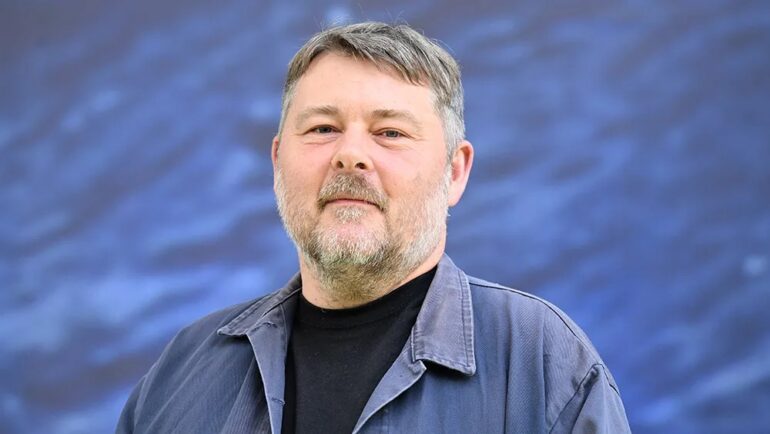
Having just arrived in Cluj, British film director Ben Wheatley spoke to us in preparation for his Masterclass about his artistic process, AI and the deterioration of film.
Welcome to Cluj, Mr. Wheatley! First of all, let’s talk about Bulk, your newest film. How did it come to pass? I know originally it started with Kosmik Musik, no?
Kosmik Musik was a graphic novel that I wrote with my friend Joe Curry, who illustrated it, and I really enjoyed writing that. I’ve always loved comics. I’ve always kind of been comic book-adjacent, and it’s something that I found opened up my writing quite a lot. I felt that I could be very free in the comic book world because the budget of drawing someone’s face is as expensive as the budget of blowing up a planet, or having a robot, or whatever. It’s only about how much time an artist will take to draw something. So it opens things up at the same time as it closes stuff down, because you don’t have sound, you don’t have music, and all those other things. So I really enjoyed it, and I found I could write in a looser, much more elastic way. And then I thought: what if I applied this to my scriptwriting? What if I wrote something that was a bit more bouncy, that could move around, that was more playful, and less about spending a lot of time with film scripts thinking about really dull stuff like three-act structure, how character arcs work, how the audience is feeling at a certain amount of time, and all these things… I just got a bit sick of it all and wanted a holiday from that. So that’s what Bulk started as.
You mentioned the idea of a holiday. You shot the film between two other major projects, no?
Well, if you look at the movies I’ve made, I’ve always done that. I kind of do a movie, and then often, while we’re making it, we’re trying to put together another movie. Sometimes that movie’s got a bigger budget, but sometimes it doesn’t come off, and then there’s a gap, and then we make something else. A Field in England is an example of that. I was in the process of making Normal, the Bob Odenkirk film I did last year. That was going to shoot in Canada, and we were waiting for the snow, so it meant that we had about six months. So I called up Andy Stark, the producer, and we were going, “Well, we could probably do a movie in this period.” We started putting that together, and then I called Alex and Sam and said, “Are you around?” And they were like, “Yeah.” And it all came together like that.
I’m curious because of how different this sounds as a production compared to Normal: What do you learn every time you do these shorter projects, with smaller budgets? What is it like to have this project compared to a big blockbuster film? What’s the difference?
Well, budgets don’t really matter when it comes to storytelling in the end, because once the shooting’s finished, once you’re in the edit suite, you’re in the same position usually. You’re just trying to make something work. So it’s a bit weird like that. More money doesn’t make things easier necessarily; it can make things harder. More money allows you to maybe have a more ambitious plan for building giant sets, but it also means you have a lot of people who want their money back once the film comes out. So then the film has to be a certain type of film. There’s no criticism of those kinds of films, but that is a different situation from making something that’s got a more modest budget, where you can make it for a smaller audience. Then you can be more adventurous with that, because it doesn’t matter that you put off a large proportion of the audience, because your audience is so small that you’re going for in the first place.
Right. I’m interested in that audience as well. You mentioned doing something adventurous for a smaller audience. What do liken it to? What do you think would be an interesting companion piece to the film?
I’ve had to do that for festivals, and we had Tetsuo: The Iron Man as one of the films I picked. Not because it’s similar, but because it comes from a kind of ethos. It was a movie that made me think I could make films from nothing, because they’d made that movie off their own backs, just in the streets of Tokyo. It was made out of bits of fireworks and stop-motion animation, but it also looks like the future. It’s an unbelievable movie. So it’s the aesthetic and the ethos of going: you can just make something. You don’t have to wait for permission, I think. That’s why I would program that one.
Is that one of the lessons you find central to filmmaking? That you don’t ned permission? Is that a sneak peak into your Masterclass tomorrow?
Yeah, but it’s not that helpful, you know? Basically, there are a lot of reasons why you don’t make films when you want to be a filmmaker. There are a lot of internal blocks that you have in terms of what you think adds worth. That stretches into all art, really. It’s trying to free yourself. Once you’re free of that, you get into a space where you’re making it and you’re just enjoying it. I think there’s a kind of weird world of accountancy, and a more conservative version of art, which is about performance. Like, every drawing has to look exactly like a photograph, and your film has to be like a blockbuster, otherwise it’s a failure. I think that’s the straightest version of what art-making is. Art-making itself can be really interesting. There’s something people don’t talk about that much, which is the feedback between you and the art as you make it. This is why the AI conversation is mostly redundant, because you don’t need to make music easier. You just need to make music that you’re making, and listen to your own music. You don’t need a machine to do it and press a button, because that’s just like turning the radio on, you know? The general conversation online about how AI is going to destroy Hollywood — does it matter? In the end, if it’s going to make really boring images, then it’s just as bad as humans making boring images.
Do you think that’s one of the things that has changed throughout the history of filmmaking? The ethos has gone too far into everything having to be photograph, and everything having to be a blockbuster?
I don’t know. I mean, if you look at what Star Wars is, Star Wars was a film that was meant to be an adaptation of Flash Gordon, but they couldn’t get the rights to it. It’s 1940s cliffhanger serials mixed with Japanese cinema. So the snake was already eating its tail very early on. I don’t think it’s a new thing. For me, I just did it because I like it. I like those films, and I like that world, and I wanted to play in it. But Bulk looks backwards and also looks forwards. It’s not a film that could have been made even a year ago. The technology is very specific in it. The way equipment is moving, and software is moving, democratises the process more and more. Part of making Bulk was to make it from stuff I could just buy off eBay. It really struck me when you watch that ILM documentary on Disney+, about building the effects work from scratch and having to build all the optical printers and the computer-controlled arms to shoot all the effects work. You can buy all that equipment now for not very much money. Pretty much, if you’ve got a small amount of disposable income, you can buy that stuff and make that film. Maybe not the sets, but certainly the spaceships.
Is that something you’re interested in doing in the future? Spaceships?
I’m just interested in keeping making movies. One of the things I was thinking about with this is that it doesn’t matter how raw the film is necessarily, as long as it’s engaging and amusing and has drama in it. A lot of that I took from drawing. If you draw stick figures that have speech bubbles, that’s fine as a comic book. You can read that stuff and it can be totally affecting. The bigger version of that is something like South Park, which is pretty crap, but it works. The first time I saw that, I was like, “Why is this so rough?” But then, within 30 seconds, you get the joke. Then you don’t notice that it’s really poorly animated. Actually, it’s an advantage. I think that’s the other end of the uncanny valley. You fill in all the detail, and you use your imagination to watch things.
Thank you for taking so much of your time to speak with me. Is there anything else you’d like to impart as a final thought?
I think that the world moves so fast, but also cinema has been in complete decline from year one. So it always looks like it’s all over, and it never is. Because in the first instances of cinema, you have stuff like the patent wars, where they patented the camera mechanisms in New York, and then it was a disaster. So people had to run away to Hollywood to start making movies there, so they were far enough away from asking for money for the copyright for using the cameras. So this is already a technological conundrum for them. Then the invention of television is a disaster. The invention of VHS is a disaster. Streaming is a disaster. It’s all the same thing. It’s always going bust and always coming up the other side. So on one hand, you get a lot of doom-mongering about it and misery. But on the other hand, if you look at it, the state of collapse is always an opportunity. It’s been like this before, and it’ll be like it again. I think the thing for me, thinking about AI, is that the reality of it is it will make a new form. The worry is not about making movies using AI. That’s a very short-term view. The real thing that’s coming is fully interactive movie stories tailored to your own prompts, that you watch and find fascinating because it’s all about you. Which is not too many steps away from playing Grand Theft Auto, except you’re completely in control of the environment and the stories that are being told, as well as interacting with them and moving through them. That’s the endgame of all this stuff. It’s not necessarily a hand-to-hand combat thing about whose jobs are going to get lost. It’s more like the rumblings of a completely new conceptual paradigm.
Ben Wheatley can be found Saturday, at the Radisson Blu Hotel on Saturday, June 20, at 11:30, and at Cinema Arta, at 14:45 for a Q&A after the projection of his newest film, Bulk.