
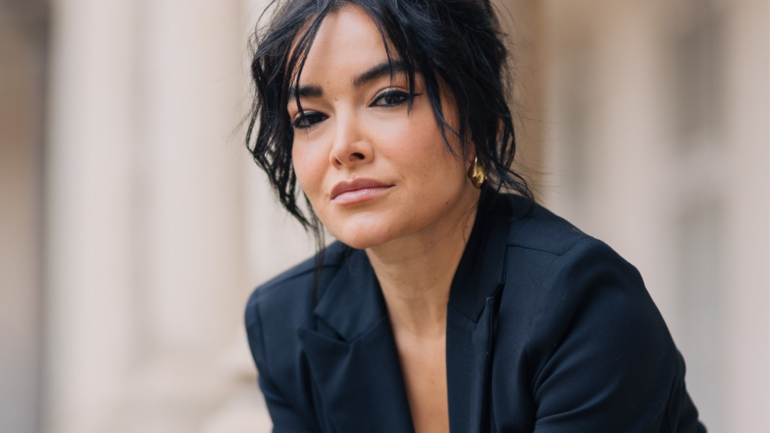
On the occasion of the screening of The Mortician, the latest film by director Abdolreza Kahani—a complex and powerful indictment of the regime in Tehran—we spoke with Golazin Ardestani, an actress, singer and a leading voice in the Iranian opposition. Arrested multiple times by Iran’s morality police for singing in public, Gola, as she is known professionally, continues to campaign from exile for the overthrow of the ayatollahs’ dictatorship. Through her work and activism, she has become a source of inspiration for thousands of people who have experienced oppression in its many forms.
You play an important role in this film, which centres on an act of resistance against the regime in which the protagonist participates. How did you become involved in the film?
I was acting in a film with Nima, who plays the lead role. While we were filming in Los Angeles, he said, “Do you want to act in another film? We’re making one in Canada with Abdolreza Kahani.” And I was like: “Of course—it’s Abdolreza Kahani.” I knew his films from back home. He had made many films with large crews.
Then Abdolreza called me after we wrapped in LA. He said, “Let’s talk,” because he had heard about my story—that, as a female singer, I cannot sing in Iran, that all my songs are protest songs, and that I cannot go back to Iran.
He asked: “Would you be comfortable with me including your story in the film?” And I said yes, because it is very important to talk about it and to raise awareness of what is happening in Iran, the situation of women, and life under the regime. And not only in Iran, but outside the country as well. So I said yes, and then we started the collaboration.
That brings me to my second question, which you have already partly answered: your character in the film is clearly based on your own life and struggle.
Yes. Basically, Jana is me. She reflects my life, although I cannot say that she has exactly my personality. She is in exile. The government does not like her. She sings protest songs. She is not going back home. She has cut ties with her family. And that is exactly my situation.
Even the stone that you see in the film, which Mojtaba unknowingly throws away, is mine. I brought it from Iran many years ago, when my dad passed away. There are so many details from my real life in the film.
The only difference between Jana and me is that she wants to take her own life. I do not share that belief. But I know some people actually feel that way.
When we were filming, we received the news that the journalist Kianush Sanjari had died by suicide after jumping from a building. His last tweet said: “We die for the love of life, not death.”
He wanted to raise awareness of what was happening in Iran. He had been arrested multiple times, imprisoned and tortured. And he said: “Enough is enough. When is this going to change?”
The news, of course, devastated us. But it also reminded us why we were making this film and why we needed to talk about this. There are so many people who are willing to give their lives in order to bring about change for future generations.
In January 2026, millions of people took to the streets in Iran, and thousands were killed by the Islamic regime—more than 50,000 people. Those are people willing to give their lives to see freedom.
So, do you think death can also be a form of freedom?
For some people, it feels as though there is no other option. It is like: “I am prepared to die if it can help bring change.”
I mean, what could be more important than a person’s life? People are not suicidal, of course, when they take to the streets. But they know they may be shot. They know that the government is using military-grade weapons and waging war on its own people. They know it.
They do it because they know that change is necessary in Iran. And that change is important not only for Iran, but for the entire world. When the regime in Iran is gone, the world will become a better place. There will be less war, less radicalism, and extremism.
Returning to the film, I do not think taking one’s own life is the answer. But there have been cases, and I had to learn about them. I had to read a lot and research the lives of the people who had taken their own lives.
What were they thinking? How were they living? Were they hopeful? Were they depressed? And I realised that most of them were not depressed. They were actually hopeful. I had to bring that into Jana’s character.
That is why Jana is a little fiery. She has so much hope. She knows and believes that what she is doing is going to bring change. And that is also true in my case.
What is exile? Exile means being completely cut off from my family, my friends and everything that made me who I am: the country, the land. I may never see many of those things again. They are memories now, and I cannot revisit them.
But I know that whatever I am doing may be only a small step. I believe in small steps. Films like The Mortician are important. They are small steps that can ignite a conversation that needs to begin.
We need to understand that the Islamic regime is active not only inside Iran, but outside the country as well. It is a danger not only to Iranians living abroad, but to society in general.
You clearly believe in the power of art to resist dictatorships and authoritarian regimes.
Absolutely, and that is why art is so heavily censored in Iran. They know the power of music. They know the power of film. They know that it reaches people emotionally.
I studied the psychology of music in London, and I realised that music was so powerful that I wanted to use it as a tool for change.
That is why I have dedicated my music to protest songs—songs that bring people together, so that we understand we are not alone. We are together in this. There is hope. There is a future.
No totalitarian regime has lasted forever in human history. They will go, but we have to do something about it.
So I completely believe in the power of film, music, and art in general. Because art travels too. It transcends language. If you see it, if you feel it, it moves you. If it moves you, then you can do something. You can take a step.
I think that is very powerful because art can also outlive us and reach more people than we ever could ourselves.
Exactly. It travels across borders. It goes to different countries. And, you know, even something as simple as this can matter: perhaps people do not know that female singers are no longer allowed to sing publicly in Iran.
Maybe they do not know what we are fighting for, what we mean when we speak about freedom or equality.
Some people on the other side of the world, when they watch this film, will understand that the issue is much deeper than what we in the West may think of when we speak about equality.
That does not mean equality does not matter here—it does. I believe in equality between women and men on many levels and in many areas of life.
But what equality means can differ greatly from one country to another. The kind of equality we are talking about is very different. What equality means in Iran is very different from what it may mean in Romania.
In Europe, the struggle is about improving something that already exists, whereas in Iran it requires changing the entire system.
Exactly. In Iran, we are talking about the absence of equality. That is why people call for the fall of the Islamic regime, because the Islamic regime is built on an ideological foundation.
So the whole system has to change. It has to fall in order for people to have freedom of choice, whether they are women or men: to choose what they wear, to have freedom of speech, to choose what films they make and what music they sing.
Women cannot even go to stadiums. When I was 16 years old, I had to shave my head in order to be able to ride a bicycle. I chose a male name for myself so that I could do what I wanted to do, so that I could play football in the street.
I had to change my identity—even my gender in my own mind—and I always wanted to be a boy. And it is not only my story. There are so many stories like mine among girls and women in Iran. And I think it is important to tell them.
For me, music has always been the medium through which I could express myself, and now film has become one as well.
I started acting when I was eight years old. And only two years ago did I decide to return to the film industry professionally. The Mortician is my debut film. But it is just the beginning.
I hope to do much more, raise greater awareness about Iran and make a difference through art.
Thinking of Hannah Arendt’s concept of the banality of evil, the film raises the moral question of “just following orders”. How do you think we can reach people who simply want to live in peace, regardless of what is happening around them or what they must do to preserve that comfort? Resisting terror requires a willingness to make sacrifices.
What I always say is: imagine you are on a plane with economy and first-class sections. If the engine fails, no matter where you are sitting, you are going to die.
Even the people in Iran who once said, “If you have money, you can live well,” or “Yes, there are limitations, but…,” are now facing difficulties they never expected, such as electricity blackouts.
When the regime is corrupt, corruption spreads everywhere, right? Now they are also affected.
When the war started, it was not against the Iranian people; it was against the Iranian regime. But people were affected, no matter how wealthy they were or what their ideology was.
So I think films and music like this can make people think and understand that it does not matter where you are standing, whether you are Iranian or non-Iranian, whether you are political or apolitical. You will be affected, because we are all connected.
We are all living in one ecosystem, wherever we are in the world. When something happens on one side of the world, it will affect people on the other side.
You cannot be free while others are not free.
No, exactly. So it is better to act and do something than to close your eyes and look the other way.
You have to understand that, if you do not do something about it now, you will be affected one way or another—or your child or grandchild will be. Because it is everyone’s problem.
Returning to the idea of sacrifice and comfort, you cannot fight tyranny and expect to face no consequences, right?
I am a first-generation immigrant. It was very difficult to learn another language, especially because I could not speak English. Studying and working were also very expensive for me.
So, when I decided to sing and act, I promised myself that what I did had to make a difference, so that the girls and women who came after me would not have to experience the same pain I went through.
And ever since, I have stuck to that promise. I kissed the walls of our home goodbye. When I left Iran in 2011, I knew that I might never return.
Is the stone in the film also a symbol of this sacrifice?
Yes. It reminds me of the land. It is the closest I can get to the land, to my father, to Iranian soil. I can touch it. I can smell it.
It is all right if I cannot go back, because I believe that every step, every interview and every song can travel far and make a difference.
Perhaps one day, because of all these interviews, films, songs and books, people will be able to return home.
Exactly—when the regime changes. Iran is going through a very difficult time, a major transition. But when the regime falls, we will regain our freedom, because we had it 47 years ago, right?
When we have it back, Iran will be a different place, as will the Middle East and the world. And people will have freedom of choice.
People will no longer be afraid of the regime’s agents, either inside or outside Iran.
Thursday, 18 June, 18:15, Military Circle
Friday, 19 June, 22:15, Sapientia University
The two screenings will be followed by a Q&A with Golazin Ardestani.